How a visionary digital nation is building a second layer of citizenship for humanity — powered by education, ethical AI, opportunity, and global participation.
Explore HUMANIA: https://ehumania.com
In a world increasingly defined by borders, inequality, technological disruption, political polarization, and uncertainty about the future of work, one bold initiative is asking a profound question:
What if humanity had a complementary nation — one not built on territory, conflict, or exclusion, but on participation, learning, opportunity, innovation, and shared human progress?
This question lies at the heart of the e-Republic of Humania, one of the most ambitious and intellectually provocative civic innovation projects emerging in the digital era.
Far more than a website, community, or virtual organization, the e-Republic of Humania proposes something radically different: a peaceful, ethical, and globally accessible second layer of citizenship — one designed not to replace national identities, but to complement them.
Its message is simple yet remarkably powerful:
“Keep Your Nationality. Gain a Global One.”
At a time when millions of people seek belonging, opportunity, international collaboration, and meaningful participation in a rapidly evolving world, Humania presents an entirely new civic model — one built for the realities of the 21st century and beyond.
What Is the e-Republic of Humania?

The e-Republic of Humania is a complementary digital nation for humanity, designed to unite people across borders through education, ethical innovation, entrepreneurship, collaboration, civic participation, and human development.
Unlike traditional states, Humania is not a sovereign country and does not seek to compete with governments or replace national citizenships. Instead, it operates as a parallel civic ecosystem — a voluntary and peaceful digital republic where individuals from every country can participate while fully respecting international law and the sovereignty of existing nations.
Its founding philosophy is built upon a simple but revolutionary belief:
Humanity deserves a shared civic space that transcends geography without erasing identity.
In Humania, citizens are not defined by birthplace, ethnicity, economic status, political divisions, or passports. Instead, participation is based on:
- Shared values
- Human development
- Contribution
- Education
- Innovation
- Collaboration
- Ethical progress
- Human + AI coexistence
Humania imagines a future where global participation becomes more important than borders alone — where opportunity is not limited by geography, and where citizenship can evolve beyond purely territorial definitions.
A Second Layer of Citizenship
Perhaps the most innovative idea behind Humania is its positioning as:
“A Second Layer of Citizenship.”
Rather than asking people to abandon their countries or identities, Humania introduces the concept of complementary citizenship.
A citizen of France remains French.
A citizen of Brazil remains Brazilian.
But they may also choose to become a Humanian — part of a global civic layer designed around cooperation, learning, opportunity, and shared human progress.
This distinction is essential.
Humania is not a political revolution.
It is a civic evolution.
Its creators envision a future in which people maintain loyalty and respect toward their nations while simultaneously participating in a larger global ecosystem dedicated to human flourishing.
In this sense, Humania could represent one of the earliest prototypes of what future historians may someday call:
“Post-territorial civic systems.”
The Founding Vision: Why Humania Exists

The world faces major challenges:
- Educational inequality
- Talent underutilization
- Youth unemployment
- Social fragmentation
- Limited international mobility
- Technological disruption
- AI uncertainty
- Economic instability
- Lack of global civic belonging
Meanwhile, digital transformation has fundamentally changed how humans work, learn, communicate, collaborate, and create value.
Yet citizenship itself has remained largely unchanged.
Humania asks:
If work became global, learning became global, and communication became global — why should civic participation remain geographically limited?
Its answer is bold:
Create a peaceful, ethical, and participatory digital nation for humanity.
A nation based not on land, but on:
Values, competence, contribution, and shared progress.
Digital Borders: Entering Humania
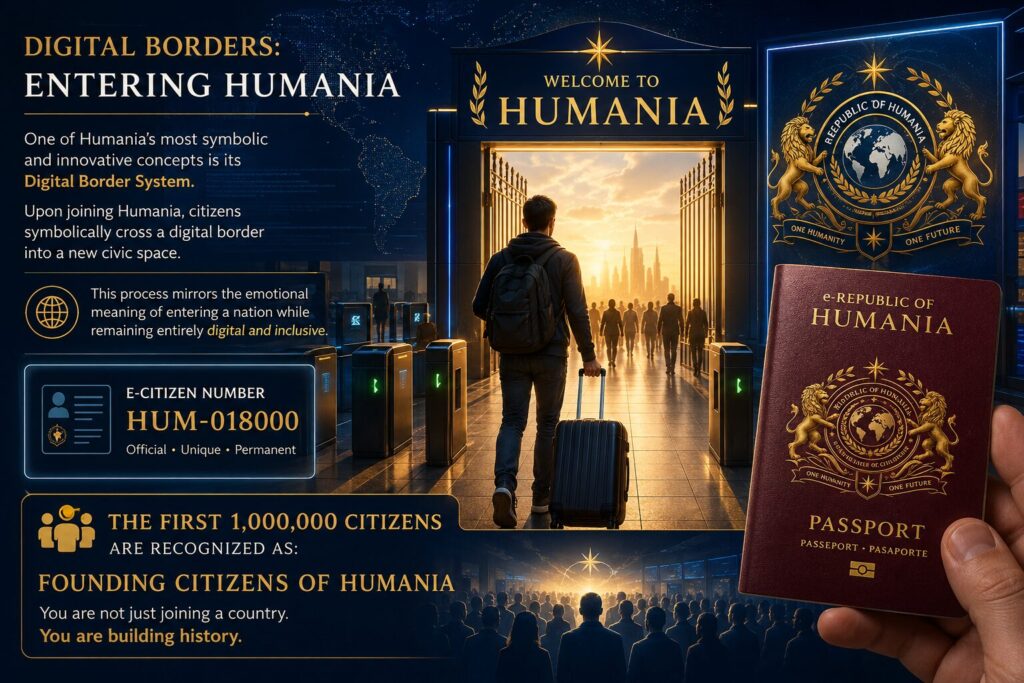
One of Humania’s most symbolic and innovative concepts is its Digital Border System.
Upon joining Humania, citizens symbolically cross a digital border into a new civic space.
This process mirrors the emotional meaning of entering a nation while remaining entirely digital and inclusive.
Each participant receives:
An Official Humania e-Citizen Number
Beginning from structured citizen sequences, each Humanian becomes part of a living civic history.
The first 1,000,000 citizens are recognized as:
Founding Citizens of Humania
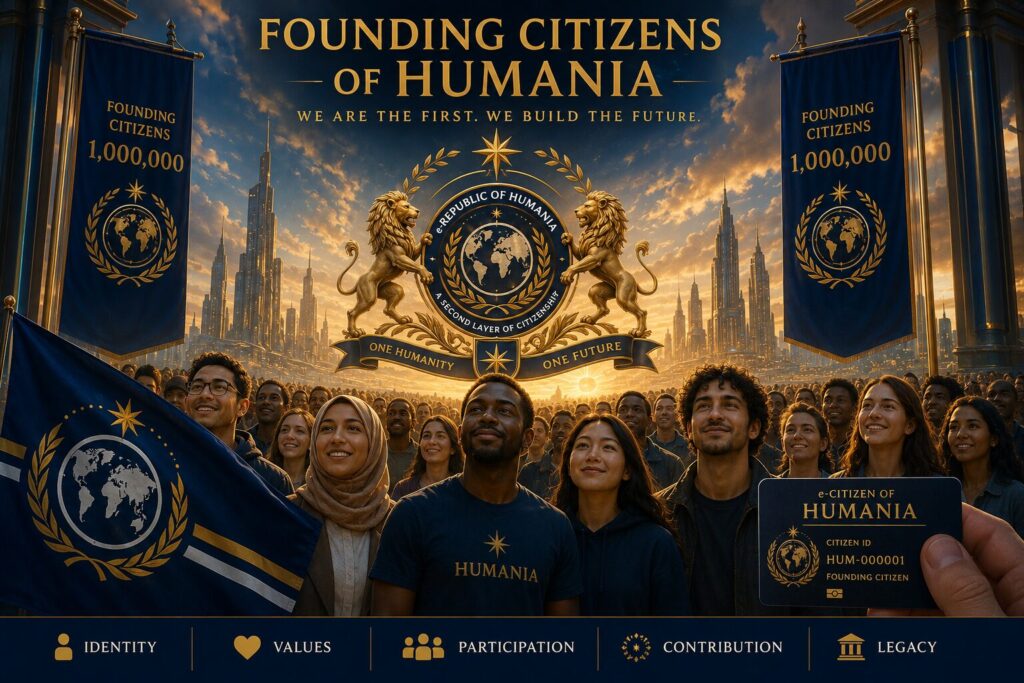
This status carries symbolic historical significance.
Humania’s founders envision the first million citizens as the people who helped shape the earliest identity, values, systems, and civic evolution of the republic.
Their stories, participation, and contributions become part of Humania’s founding memory.
This creates something surprisingly powerful:
A sense of belonging.
Not based on geography.
But based on shared participation in building something new.
The Humania Survey: Building a e-Nation With e-Citizens
Perhaps one of the most intellectually sophisticated elements of Humania is its Founding Citizen Survey System.
Rather than imposing a top-down model of governance and priorities, Humania asks its citizens:
What kind of nation should Humania become?
New citizens contribute ideas related to:
- Governance preferences
- Civic priorities
- Education
- Innovation
- Ethics
- AI participation
- Economic systems
- Opportunity creation
- Future institutions

This transforms Humania from a static project into something far more dynamic:
A nation co-designed by its citizens.
In many ways, Humania is conducting one of the most ambitious civic experiments of the digital age:
Building a country through collective intelligence.
Humans + Ethical Artificial Intelligence
Unlike many initiatives that portray artificial intelligence as a threat, Humania takes a fundamentally different position.
Humania imagines a future of:
Human + Ethical AI Collaboration
In this vision:
AI does not replace humanity.
AI amplifies humanity.
Human expertise, creativity, ethics, and emotional intelligence remain central.
But ethical AI systems may help citizens:
- Learn faster
- Work smarter
- Access education
- Build companies
- Solve problems
- Collaborate globally
- Access services
- Receive assistance
Humania sees AI not merely as technology — but as a future civic partner.
This philosophy represents one of the republic’s most forward-thinking dimensions.
Rather than fearing technological transformation, Humania seeks to guide it ethically.
Education as a Civic Foundation
Education occupies a central place inside the Humania vision.
Rather than treating learning as optional, Humania frames it as one of the pillars of civic empowerment.
Inside Humania, citizens may gain access to:
Training & Education Ecosystems
Programs designed to support:
- Skills development
- Professional growth
- Entrepreneurship
- Innovation
- Future careers
- Leadership
- Personal development
The philosophy is competency-based rather than bureaucratic.
Humania asks:
What can people become if education becomes globally accessible?
This aligns with a future where learning becomes lifelong, borderless, and personalized.
Humania Work: A Global Opportunity Layer
Future Humania development includes:
Humania Work
A collaborative ecosystem for:
- Freelancers
- Digital nomads
- Professionals
- Consultants
- Creators
- Entrepreneurs
- Innovators
Instead of opportunity being constrained by geography, Humania envisions a civic network where talent connects globally.
A designer in Nigeria may collaborate with a startup in Japan.
A researcher in Brazil may partner with innovators in Germany.
A creator in India may work with institutions in Canada.
Humania seeks to become:
A borderless layer of human opportunity.
Humania Companies Registry
Humania also introduces a unique concept:
A Humania Companies Registry
Businesses, NGOs, institutions, startups, and projects may establish a digital Humania presence.
This creates opportunities for:
- International visibility
- Collaboration
- Cross-border participation
- Innovation partnerships
- Civic engagement
Humania does not imagine business as separate from civic life.
Instead, entrepreneurship becomes part of social progress.
The Humania Economy and HUMA (Ӈ)
No modern civic ecosystem is complete without economic participation.
This is where HUMA (Ӈ) enters the Humania vision.
HUMA is designed as an:
Honorary and Utility eCurrency
Unlike speculative cryptocurrencies, Humania positions HUMA as a practical and civic tool.
Citizens may someday use HUMA for:
🎓 Learning Rewards
Recognition for education, certifications, learning participation, and skill development.
💼 Services & Collaboration
Exchange between citizens for freelance work, projects, and expertise.
🏛 Civic Participation
Recognition for contribution, volunteering, innovation, and community engagement.
🤖 Human + AI Services
Supporting collaborative ecosystems involving ethical AI assistance.
Importantly, Humania emphasizes freedom.
HUMA is optional.
It does not replace national currencies.
Instead, it complements Humania’s ecosystem while respecting economic diversity.
Humania Fund: Investing in Human Potential
Future Humania development also includes:
The Humania Fund
Designed to support:
- Citizen innovation
- Humanitarian initiatives
- Startups
- Education
- Community projects
- Social impact programs
The philosophy is clear:
Human potential deserves support.
Humania imagines a future where civic systems actively help citizens build meaningful lives.
A New Civic Imagination
Critics may call Humania idealistic.
Supporters may call it visionary.
Yet history repeatedly reminds us:
Every transformative system once seemed impossible.
Universities.
Democracies.
Digital economies.
The internet itself.
At its core, Humania represents something deeply human:
The desire to belong to something larger than ourselves.
Not through division.
But through cooperation.
Not through conquest.
But through contribution.
Not through fear.
But through possibility.
Could Humania Become Historic?
The answer depends not on technology alone.
But on participation.
If Humania succeeds, it may become:
- A new model of global civic participation
- A prototype for digital citizenship
- A framework for ethical human-AI cooperation
- A borderless opportunity ecosystem
- A new educational civilization model
Most importantly, it may prove something many people have quietly hoped for:
Humanity can still imagine new systems built on ethics, learning, dignity, and shared progress.
The Future of the e-Republic of Humania
The future of Humania remains unwritten.
That, perhaps, is its greatest strength.
Unlike traditional institutions shaped entirely from above, Humania is being built with participation at its center.
Every new citizen contributes to its story.
Every survey shapes its direction.
Every contribution expands its possibilities.
The first million citizens will not merely join Humania.
They will help define it.
And in an era increasingly shaped by digital transformation, global uncertainty, and artificial intelligence, one idea feels increasingly relevant:
Perhaps the future of civilization is not less human.
Perhaps it is more Humania.