A New Chapter in Human Civilization Begins
In a century defined by technological acceleration, global mobility, artificial intelligence, digital identity, and rising social fragmentation, one question increasingly emerges across societies, institutions, and generations:
What comes next for humanity?
While nations remain essential pillars of identity, governance, and culture, many people around the world are beginning to feel the limitations of borders when confronting global challenges. Climate change, inequality, education gaps, digital exclusion, economic uncertainty, skills disruption caused by artificial intelligence, and the growing disconnect between citizens and institutions all point to a deeper truth:
Humanity needs a new complementary layer of global belonging.
This is where HUMANIA enters the conversation.
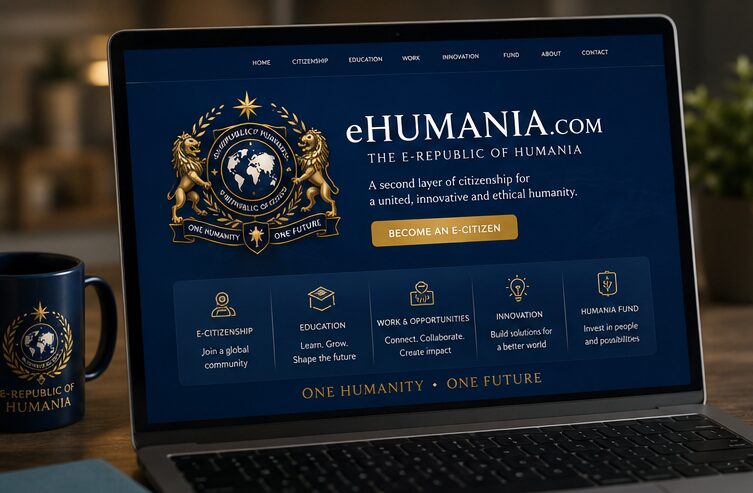
Explore Humania: https://ehumania.com
More than an idea, more than a platform, and more than a symbolic movement, Humania is emerging as one of the most ambitious digital civilization projects of the new era — a hybrid model combining civic participation, global identity, ethical innovation, education, economic opportunity, and human-centered technology.
Known officially as the e-Republic of Humania, the initiative introduces a bold yet practical concept:
“Keep your nationality. Gain a global one.”
Unlike traditional political projects or utopian experiments, Humania does not seek to replace countries, governments, or national sovereignty. Instead, it proposes something profoundly innovative:
A second layer of citizenship designed for the interconnected realities of the modern world.
What Is Humania?
At its foundation, Humania is a global e-Republic — a digital nation built not on geography, but on values, participation, opportunity, education, ethics, and collective human development.
The concept challenges one of the oldest assumptions in human civilization:
That citizenship must be exclusively tied to territory.
Humania asks a different question:
Can a nation exist through shared values, digital infrastructure, ethical principles, education, and global participation rather than physical borders?
Its answer is clear:
Yes — and the future may depend on it.
The e-Republic of Humania positions itself as a complementary digital nation, meaning citizens remain loyal to their countries while gaining access to a broader global ecosystem focused on opportunity, innovation, learning, civic participation, and international collaboration.
Humania is not about division.
It is about connection.
Not replacing identities.
But expanding them.
Not centralized control.
But collective participation.
A Second Layer of Citizenship for Humanity
One of Humania’s most innovative concepts is its idea of e-Citizenship.
Citizens of Humania receive a unique digital identity and become part of a growing international civic ecosystem.
Yet unlike conventional citizenship systems, Humania’s model is not restricted by birthplace, race, religion, political ideology, economic class, or passport privilege.
Its vision is radically inclusive.
Anyone, from anywhere in the world, can participate.
This transforms citizenship from something inherited by geography into something strengthened by participation.
The Humania philosophy suggests that the future may require citizens who are not only members of countries but also members of humanity itself.
Within the Humania system, individuals become part of:
- A global digital civic community
- International learning opportunities
- Ethical AI participation systems
- Surveys and citizen consultations
- Future work and service ecosystems
- Innovation-driven economic opportunities
- Global recognition frameworks
- Human-centered governance experimentation
The model reflects a growing realization:
The future citizen may no longer belong to just one reality.
But to multiple interconnected layers of society.
Why Humania Matters in the Age of Artificial Intelligence
Artificial intelligence is rapidly reshaping education, employment, governance, economics, and human behavior.
Yet many global conversations around AI remain dominated by fear, regulation battles, and technological competition.
Humania introduces another perspective:
What if AI became a partner in ethical civilization-building?
The e-Republic proposes a framework where humans remain at the center, while AI serves as a tool for:
- Ethical decision support
- Citizen engagement
- Educational personalization
- Civic consultation
- Opportunity matching
- Skills development
- Global knowledge sharing
Humania envisions a future where AI does not replace human wisdom but amplifies it.
This philosophy stands in contrast to dystopian fears surrounding artificial intelligence.
Instead of building systems that dominate people, Humania explores how ethical AI could strengthen participation, transparency, and human flourishing.
The project has already conceptualized future systems involving:
AI-Assisted Civic Participation
Citizens participating in consultations about education, ethics, innovation, urban priorities, governance models, economics, and future societal systems.
Ethical AI Governance
AI acting not as ruler, but as an assistant to human decision-making, helping societies better understand large-scale citizen sentiment and emerging challenges.
Personalized Education & Skills Development
AI helping citizens navigate future careers, entrepreneurial opportunities, and learning pathways adapted to their ambitions.
In many ways, Humania positions itself as one of the earliest attempts to imagine:
What ethical civilization could look like in the age of intelligent systems.
Humania as a Practical Ecosystem — Not Just an Idea
Perhaps what makes Humania particularly compelling is that it does not stop at philosophy.
It seeks implementation.
Rather than existing as a symbolic manifesto, Humania is being developed as a functional ecosystem with practical services and structures.
Among its envisioned components are:
1. Humania e-Citizenship
A digital civic identity allowing citizens to participate in the Humania ecosystem while preserving their national identities.
The first generation of citizens is expected to play a historic role.
Humania introduces the concept of Founding Citizens, where early participants become part of the first civic generation shaping the system’s evolution.
2. Humania Education & Learning Ecosystem
Education is central to Humania’s philosophy.
The project recognizes that in a rapidly changing world, lifelong learning is no longer optional.
Humania aims to create learning opportunities focused on:
- Future skills
- Entrepreneurship
- Technology literacy
- Ethics and leadership
- Innovation management
- AI understanding
- Human development
- Global citizenship
The vision is simple:
Empowered humans build stronger civilizations.
3. Humania Work & Opportunity System
As automation transforms industries, Humania explores models where citizens can connect to:
- Global freelance opportunities
- Ethical digital work ecosystems
- International collaboration
- Innovation projects
- Entrepreneurial initiatives
The ambition is to reduce barriers between talent and opportunity.
In Humania’s model, potential matters more than location.
4. Humania Companies Registry
Humania also envisions an ecosystem where businesses aligned with ethics, innovation, sustainability, and social value can become part of a wider international framework.
This could support:
- Ethical entrepreneurship
- International visibility
- Trusted digital business ecosystems
- Global networking opportunities
In a world increasingly shaped by trust and digital credibility, such structures may become increasingly valuable.
5. Humania Fund
Among the most promising concepts is the future Humania Fund.
Rather than functioning solely as an economic mechanism, the Humania Fund is envisioned as a support structure for:
- Innovation projects
- Human-centered startups
- Education initiatives
- Social impact programs
- Community growth initiatives
Its purpose reflects Humania’s broader mission:
Creating opportunity, not dependency.
Democracy Reimagined Through Surveys & Civic Participation

One of Humania’s most intriguing innovations lies in its emphasis on citizen consultation.
Rather than limiting civic participation to periodic elections, Humania proposes a more dynamic model:
Continuous civic dialogue.
Citizens could participate in surveys and consultations around topics such as:
- Governance preferences
- Education priorities
- Economic systems
- Ethics and technology
- AI participation
- Civic development
- Constitution evolution
- Opportunity creation
- Social priorities
This creates an adaptive civic model where citizens continuously contribute to the direction of the ecosystem.
In many ways, Humania seeks to merge:
Democracy + technology + participation + ethics.
Can a Nation Exist Without Borders?
Perhaps the most revolutionary question Humania raises is philosophical.
Can a nation exist without land?
Historically, nations have relied on territory.
But in the digital age, many of humanity’s most influential systems already transcend geography:
The internet.
Digital economies.
Remote work.
Online education.
Virtual communities.
Global commerce.
Knowledge exchange.
Humania suggests that the next evolution of civilization may not eliminate physical nations but complement them through digital civic structures.
This idea may sound radical today.
Yet many transformative ideas initially did.
What once sounded impossible often becomes inevitable.
Why Humania Could Become One of the Defining Experiments of the 21st Century
Throughout history, societies evolve when bold ideas meet practical systems.
Humania appears to stand precisely at this intersection.
Its strength lies in balancing:
Vision + implementation
Idealism + practicality
Technology + ethics
Innovation + human values
Rather than presenting itself as fantasy, Humania seeks gradual, participatory development.
A system built with people.
Not imposed on people.
If successful, Humania could influence how future generations think about:
- Citizenship
- Global belonging
- Ethical AI
- Education
- Civic participation
- Digital governance
- Human collaboration
And perhaps most importantly:
What it truly means to belong to humanity.
The Beginning of a New Era?
The e-Republic of Humania is still in its early journey.
Yet early-stage ideas often matter most.
Because history rarely begins with certainty.
It begins with imagination.
The internet once seemed impossible.
Remote work seemed unrealistic.
Digital identity sounded futuristic.
Artificial intelligence was science fiction.
Today, all are realities shaping modern civilization.
Humania may represent another emerging frontier.
Not merely a project.
But a question humanity may increasingly need to answer:
Can we build a second layer of civilization designed not by borders, but by shared human purpose?
If the answer is yes, then Humania may not simply be a digital experiment.
It may become one of the defining civic innovations of the modern age.
One humanity. One future. One evolving global community.
Welcome to Humania.